
Group 04 - Sistema sem fios inteligente para localização de wafers e gelpacks
![[Vídeo do projeto]](/projects/group04/thumbnail.jpeg)
| Team: |
Group 04: André Neves (Coord.) , Lourenço Ribeiro , Nuno Moutinho , Diogo Oliveira |
| Company: | PICadvanced |
| Supervisors: |
Armando Rocha (DETI)
Carla Rodrigues (PICadvanced) |
This project aims to implement an innovative solution for the traceability and monitoring of gelpacks and wafers inside the cleanroom, using RFID technology. In a context where operational efficiency is crucial, the proposed system seeks to identify and locate gelpacks and wafers in real time. This approach aims to minimise human errors and facilitate the search for components. To ensure its effectiveness, the project follows an iterative and practical approach, integrating new technologies and validating their application through tests under real conditions, adapted to the specific needs of the partner company.
Here should go the full text of the Project. You should not repeat what is in the summary written above. Instead, you should provide more details about the project, its objectives, the challenges faced, the results obtained, and any other relevant information that helps to understand the project’s value and achievements. Try to maintain the structure indicated below, so that people reading the page can easily find the information they are looking for and they have a coherent view of all projects presented on the site.
Challenge
The main challenge of this project lies in the need to automate inventory management and the precise localization of wafers and gelpacks (individualized chips) within PICadvanced’s storage drawers, without compromising the integrity of the components or the airtightness of the Clean Room environment.
Key Challenges (Strategic and Operational Challenges) These challenges focus on why the project is difficult from a Clean Room operational perspective: End-to-End Flow Traceability: Monitoring the complete lifecycle of the component, from drawer storage to the test bench, ensuring that no item “disappears” during the transition. Zero Intrusiveness: Implementing RFID technology without altering cleaning protocols or the physical integrity of the wafers and gelpacks, which are extremely sensitive to contamination. Modular Scalability: Ensuring the system is flexible enough to support production growth, allowing for the addition of new benches and cabinets without restructuring the software base.
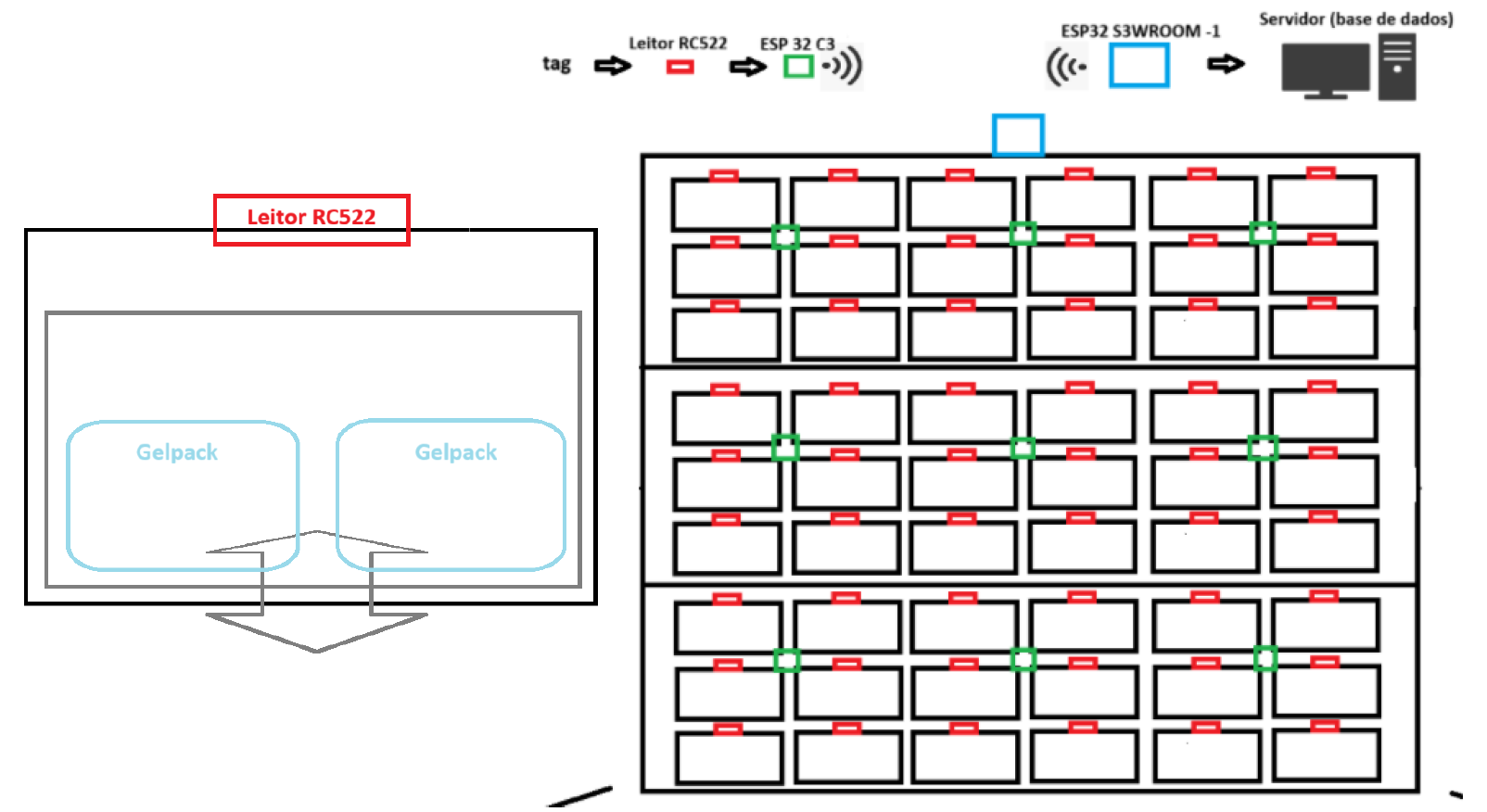
Technical Challenges (Technical and Engineering Challenges) These focus on the “how” and the physical barriers of RFID technology: Spatial Resolution and Granularity: Achieving precise localization within a drawer (e.g., left side vs. right side), which requires proper antenna positioning to avoid false positives from adjacent tags. Electromagnetic Interference: Mitigating signal interference related to the ESP-NOW protocol and other wireless communications within the environment. Tag Miniaturization: Selecting and applying RFID tags that are small enough for the gelpacks without compromising reading range or the thermal stability required during the processes.
Results
 Operational Flow and Communication Infrastructure
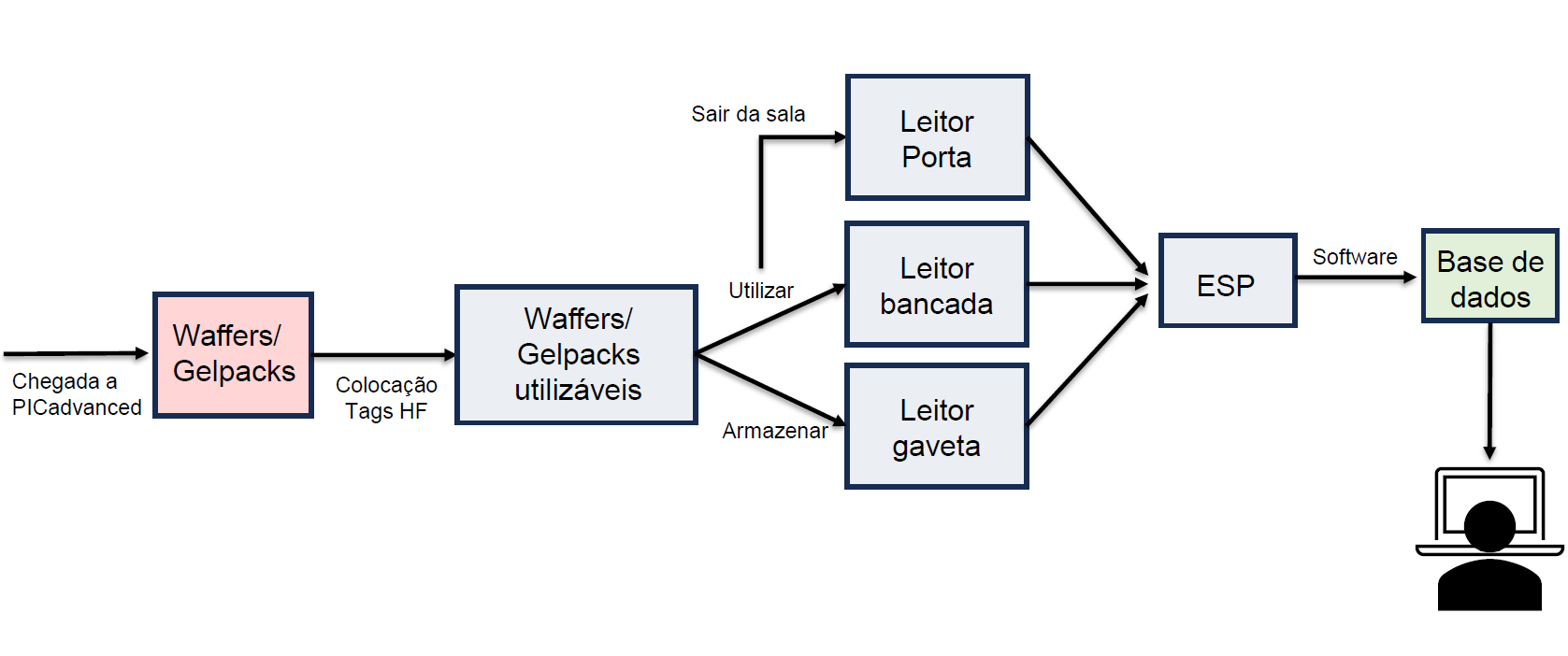
The system operates through an intelligent monitoring network designed to track the lifecycle of wafers and gelpacks from the moment they arrive at PICadvanced. This workflow is supported by a Master/Slave architecture linked via the ESP-NOW protocol. Upon arrival, components are fitted with HF RFID tags, and as they pass through the Clean Room entrance, an ESP Slave configured as a Door Reader detects the entry and communicates the status to the central system. When a component is subsequently stored, the Drawer Reader Slave identifies not only the specific drawer number but also its precise position within the left or right row—a level of detail implemented as a successful extra feature to ensure rigorous inventory precision.
Operational Flow and Communication Infrastructure
The system operates through an intelligent monitoring network designed to track the lifecycle of wafers and gelpacks from the moment they arrive at PICadvanced. This workflow is supported by a Master/Slave architecture linked via the ESP-NOW protocol. Upon arrival, components are fitted with HF RFID tags, and as they pass through the Clean Room entrance, an ESP Slave configured as a Door Reader detects the entry and communicates the status to the central system. When a component is subsequently stored, the Drawer Reader Slave identifies not only the specific drawer number but also its precise position within the left or right row—a level of detail implemented as a successful extra feature to ensure rigorous inventory precision.
If a component is removed for processing, a Bench Reader Slave records its presence at the corresponding workstation, ensuring the system remains updated even if the component is moved between different benches or transferred to another drawer. All these Slave modules (Door, Bench, and Drawers) send captured data in real-time to a central ESP Master via ESP-NOW. This technological choice provides robust wireless communication that maintains the integrity of the Clean Room by eliminating the need for complex cabling. Finally, the ESP Master acts as the system’s core, forwarding all received information to a Database, where it is made available through management software. This allows users to instantly verify if a chip is currently stored, in use, or has exited the facility by passing through the door reader again.
More information
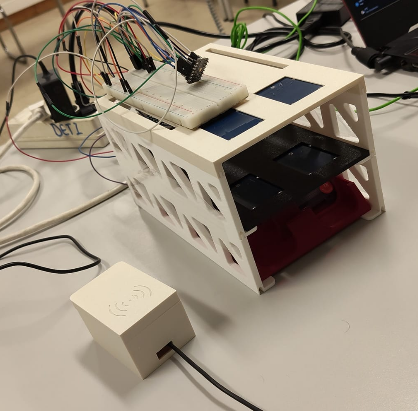 This figure shows our hardware implemented, operating, and simulating two drawers and a countertop/door.
The key results include:
This figure shows our hardware implemented, operating, and simulating two drawers and a countertop/door.
The key results include:
Reading Reliability: Successful identification and individual reading of RFID tags applied to gelpacks and wafers.
Robust Wireless Communication: Effective implementation of the ESP-NOW protocol between Master and Slave modules, ensuring low latency and low power consumption during data transmission.
Localization Granularity: Optimization of antenna positioning, allowing for precise differentiation between the left and right rows of each storage drawer, successfully overcoming the spatial resolution challenge.