Group 05 - Wireless Display
![[Vídeo do projeto]](/projects/group05/prototipo_final.png)
| Team: |
Group 05: Paulo Fernandes (Coord.) , Afonso Vaz , Catarina Castanheira , João Marques , Rafael Almeida , Samuel Santos |
| Company: | Bosch Termotecnologia, SA |
| Supervisors: |
Osvaldo Pacheco (DETI/UA)
Ricardo Rodrigues (Bosch Termotecnologia, SA) |
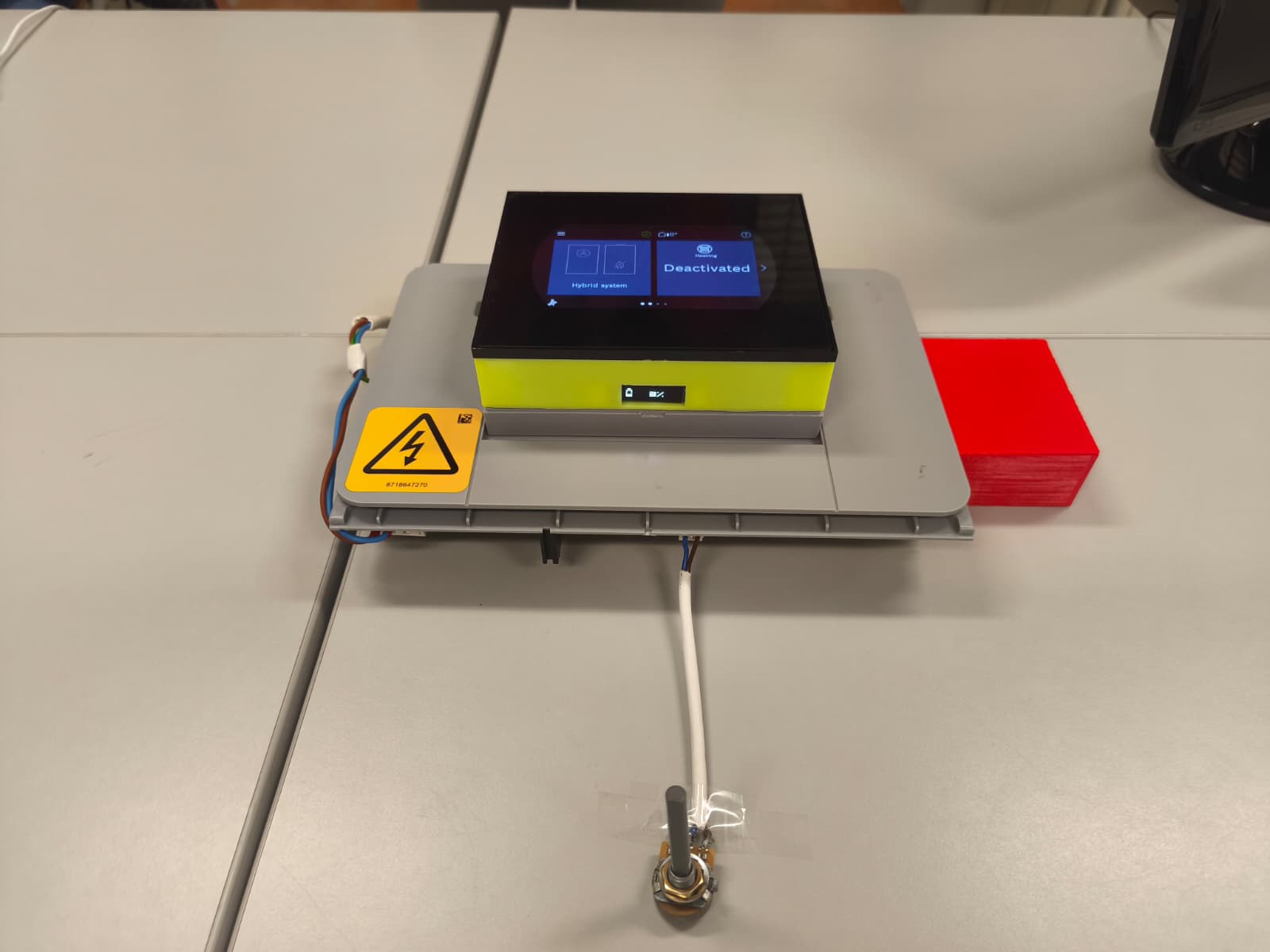
The Wireless Display project, developed for Bosch Termotecnologia, SA, introduces a portable solution for the Human-Machine Interface (HMI) of water heaters. By virtualizing a physical UART connection through Bluetooth Low Energy (BLE), it grants technicians freedom of movement within a 10-meter range. Featuring advanced power management with over 4 hours of autonomy, a custom 3D-printed enclosure with magnetic mounting, and real-time OLED monitoring, it redefines maintenance efficiency.
- Challenge
- Proposed Solution
- System Architecture
- Hardware Implementation
- Software Architecture
- UART Virtualization
- Battery Monitoring and User Interface
- Results
- Conclusion
Challenge
During maintenance operations on Bosch water heating systems, technicians often face limited accessibility to the Human-Machine Interface (HMI). When the system chassis is opened for diagnostics, the HMI display may be positioned in an unfavorable orientation, forcing constant movement between the equipment and the controls.
The main challenge of this project was to make the HMI portable by virtualizing the existing wired UART communication into a wireless link, without modifying the original Bosch equipment. The solution needed to ensure:
- Reliable peer-to-peer wireless communication using BLE;
- A minimum operational range of 10 meters;
- Seamless switching between wired (acoupled) and wireless (decoupled) modes;
- Sufficient autonomy for real maintenance scenarios.
Proposed Solution
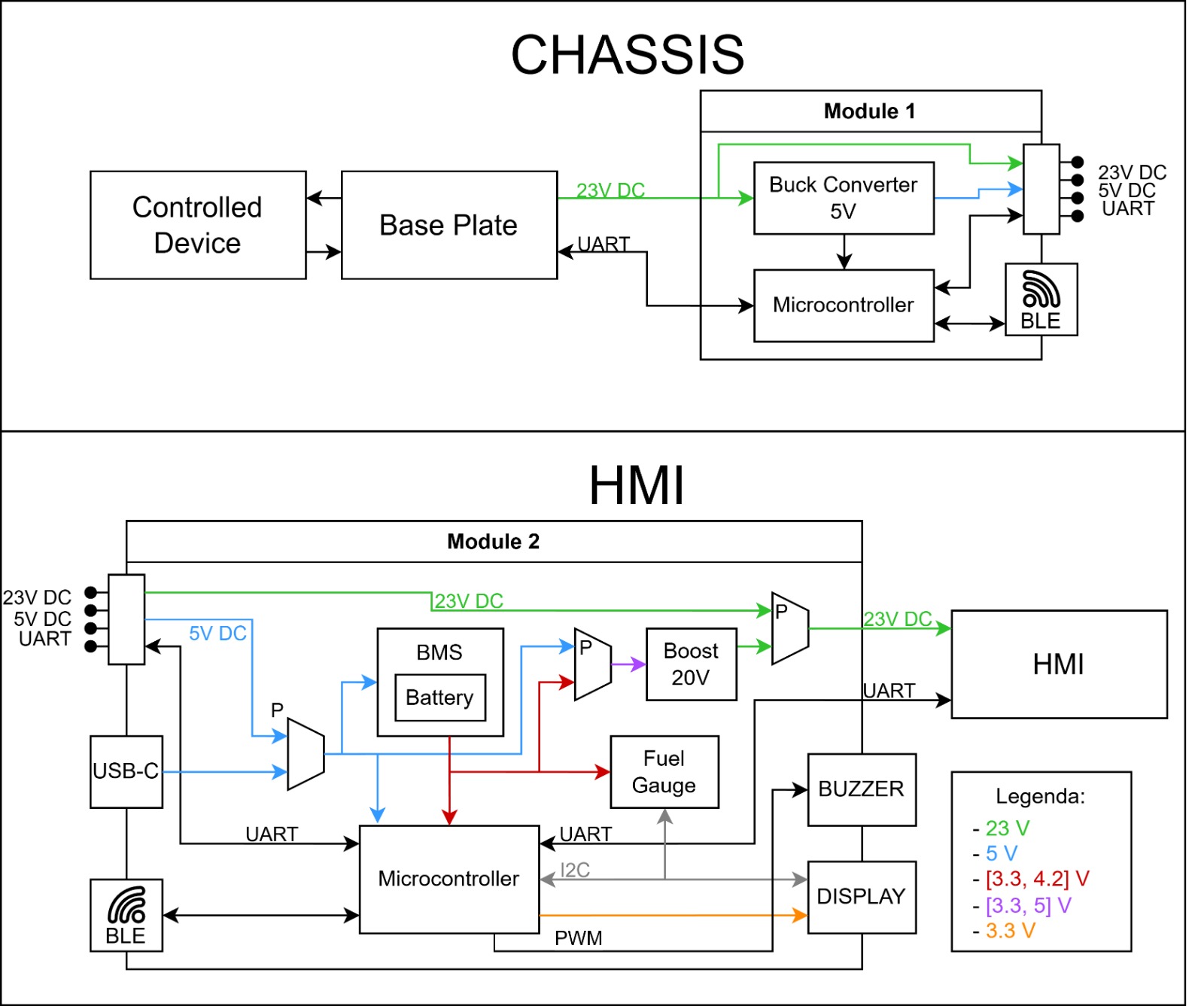
The proposed solution introduces two additional electronic modules that transparently bridge the wired and wireless domains:
- Module 1 - Base Plate: Permanently installed inside the equipment, intercepting the UART communication and acting as the BLE server.
- Module 2 - HMI Module: Attached to the HMI, containing the BLE client, battery, power management circuitry, and user feedback peripherals.
When the HMI is acoupled to the chassis, communication remains fully wired. When it is decoupled, the system automatically switches to BLE communication, preserving data flow and system behavior.
System Architecture
The system architecture is centered on the virtualization of a physical UART link:
- UART RX/TX data is captured by the ESP32 microcontrollers;
- Data is packetized and transmitted over BLE;
- On the receiving side, data is reconstructed and written back to the physical UART interface.
Both modules are based on ESP32 microcontrollers with native BLE support. Module 2 integrates a Li-Po battery and a power-path management system that selects the appropriate energy source depending on the operating mode (battery, chassis power, or USB-C charging).
Hardware Implementation
Electronic Hardware
- Module 1: Implemented using an ESP32-C3 and a buck converter to generate the required 5 V supply. Due to its low complexity, a perfboard prototype was sufficient.
-
Module 2: Implemented on a custom-designed PCB using an ESP32-C6, chosen for its low-dropout internal regulator and battery charging capability. The PCB integrates:
- Battery management and protection;
- Power-path selection circuits;
- Boost and buck converters;
- Fuel gauge for battery monitoring;
- OLED display and buzzer for user feedback.
Mechanical Design
The mechanical structure was designed to support the additional electronics while maintaining usability:
- Custom 3D-printed enclosure;
- Magnetic attachment to the chassis;
- Pogo-pin interface to allow automatic charging when acoupled;
- Materials selected to avoid attenuation of BLE radio signals.
Software Architecture
The firmware for both modules was developed using FreeRTOS and ESP-IDF, following a modular task-based architecture. The main tasks include:
- BLE connection management;
- UART reception and transmission;
- Data buffering and synchronization between wired and wireless domains;
- Battery monitoring and user alerts (Module 2 only).
Communication between tasks is implemented using FreeRTOS queues and shared data structures protected by mutexes.
UART Virtualization
A major technical challenge was the non-standard implementation of the UART protocol used by the Bosch system, including the use of signal breaks and strict timing constraints.
Since the protocol specification was not available, reverse engineering techniques were applied using oscilloscopes and logic analysis. A heuristic algorithm was developed to:
- Detect UART breaks over message;
- Preserve message structure and timing as accurately as possible.
Due to very tight timeout constraints during the initial pairing phase, full wireless virtualization during startup was not feasible. The adopted solution performs the initial pairing in wired mode and switches to wireless communication afterward.
Battery Monitoring and User Interface
Module 2 includes a battery monitoring system that continuously tracks the battery’s operating condition. The system periodically reads battery-related parameters and processes this information to estimate the remaining charge level.
The acquired data is then used to:
- Display the current battery status and charge level on a small OLED screen;
- Trigger audible alerts through a buzzer when the battery level drops below a predefined threshold.
This mechanism allows the user to monitor the energy state of the system in real time and ensures reliable operation during maintenance tasks, preventing unexpected shutdowns due to low battery.
Results
The developed prototype meets and, in some aspects, exceeds the initial project objectives:
- Stable BLE communication over distances exceeding 10 meters in indoor environments;
- Autonomous operation for more than 5 hours of intermittent use;
- Seamless transition between wired and wireless operation;
- Reliable power management and battery monitoring;
- Improved ergonomics and maintenance efficiency.
The following video shows the final prototype in its full capability:
Conclusion
The Wireless Display project demonstrates a practical and robust solution for making existing industrial HMIs portable without altering the original system. By combining embedded systems design, wireless communication, and efficient power management, the project delivers clear added value for maintenance technicians and provides a strong foundation for future product refinement and industrialization.